New Subdivisions in Drury and Karaka: Why Brand-New Homes Still Need a Building Inspection

New Subdivisions in Drury and Karaka: Why Brand-New Homes Still Need a Building Inspection
The southern growth corridor between Drury and Pukekohe is transforming at a pace that’s hard to overstate. Auranga is delivering over 1,000 homes on the Pahurehure Inlet. Paerata Rise is building a 4,500-home community between Karaka and Pukekohe.
Kiwi Property’s Drury Metropolitan Centre will eventually accommodate up to 60,000 residents across a 1,900-hectare development zone, complete with new rail stations, a Costco, and large-format retail. For buyers in the Franklin district, the opportunities are significant — but so is the assumption that a brand-new home doesn’t need a building inspection.
That assumption is wrong, and the data proves it.
The Numbers Don’t Lie
In the year to May 2025, over a third of residential new builds in Greater Auckland failed their final council inspection. The failure rates span critical construction elements: framing defects accounted for 27% of failures, cavity wrap issues 25.6%, cladding problems 22.1%, foundation flaws 15.2%, and drainage failures 14.5%. These aren’t cosmetic issues — they’re the kind of defects that lead to moisture penetration, structural compromise, and long-term damage, echoing the leaky-building crisis of the 1990s and 2000s.
BRANZ research paints a similar picture nationally, finding that 86% of new homeowners needed to call back builders or tradespeople after moving in. A separate study found that 81% of new residential buildings had defects at handover. Auckland Council’s chief building inspector has publicly documented cases of deliberate concealment, including tape placed over framing defects to hide non-compliant work.
Why a Code Compliance Certificate Isn’t Enough
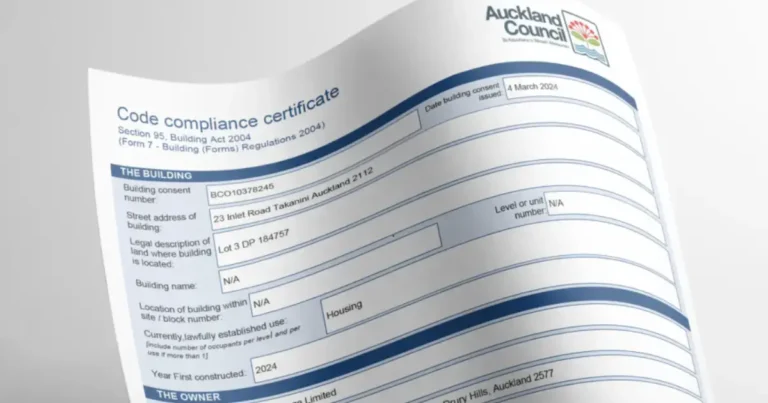
Many buyers purchasing off-plan or in new subdivisions take comfort in the Code Compliance Certificate issued at the end of the build process. A CCC confirms that the building work was completed in general accordance with the consented plans — but it’s not a guarantee of quality, nor is it a comprehensive assessment of defects.
Auckland Council conducts between 700 and 800 building inspections every day. With an average failure rate of 25%, that equated to approximately 40,000 failed inspections in the year to 2025. Council inspectors focus on Building Code compliance at specific stages of construction.
They don’t assess finishing quality, conduct moisture testing on completed surfaces, or evaluate how well different trades have coordinated their work. A home can receive a CCC and still have poorly sealed wet areas, inadequate falls on decks, and plumbing issues that compound over time.
An independent pre-purchase or pre-settlement inspection fills this gap. It’s a comprehensive visual assessment of the completed property, conducted by a trade-qualified inspector who understands what good workmanship looks like — and what it doesn’t.
What We Find in New Builds
In our experience inspecting new homes across the Franklin growth corridor — from Auranga and Drury through to Karaka and Paerata — the most common issues fall into several categories.
Moisture and weathertightness remain the biggest concerns. Poorly installed flashings around windows, inadequate sealing at deck-to-wall junctions, and incomplete waterproofing in bathrooms and en-suites are issues we encounter regularly. In a district where rainfall averages around 1,200mm per year, and humidity is consistently high, even minor gaps in the building envelope can lead to significant moisture problems within a few years.
Drainage is another frequent issue. New subdivisions in the growth corridor are built on what was recently farmland, much of it on Franklin’s moisture-retentive volcanic soils. Proper stormwater management and site drainage are critical, yet we regularly find incomplete exterior drainage, poorly graded surfaces that direct water toward foundations rather than away from them, and retaining walls without adequate drainage provisions.
Interior finishing defects — while less serious than structural issues — are also common. Poorly hung doors, gaps in joinery, paint defects, cracked tiles, and incomplete sealant work are all items the builder should rectify under warranty. But they’ll only be fixed if identified and formally notified before settlement. Our inspectors document these thoroughly so you have a complete record to present to the builder.
The Growth Corridor Challenge
The scale of development in Drury, Karaka, and Paerata brings specific pressures on construction quality. Volume builders working across multiple sites face challenges in coordinating subcontractors, overseeing quality, and maintaining delivery pace. When demand is high and the pipeline is full, corners can be cut — sometimes deliberately, sometimes through time pressure.
The three new rail stations under construction at Drury, Ngākōroa, and Paerata are expected to be operational by mid-2026 and mid-2027, further accelerating demand for housing in these areas. For first home buyers entering the market in these new subdivisions, the temptation to skip an inspection on a brand-new property is understandable but misguided.
When to Book Your Inspection
For new builds, timing matters. A pre-settlement inspection should be booked after the CCC has been issued, but before you complete settlement. This is your window to identify defects and have them documented so the builder is formally notified within the 12-month defect liability period. If you’re purchasing off-plan, build the cost of an inspection into your budget from the start — it’s typically a fraction of the cost of fixing even one significant defect after settlement.
If you’re buying a recently completed home in one of the new subdivisions — one that’s already been through its first owner — a standard pre-purchase inspection applies. Pay particular attention to how the property has weathered its first year or two, whether any defects have been addressed, and whether the construction materials and systems are performing as they should.
New Subdivisions in Drury and Karaka: Why Brand-New Homes Still Need a Building Inspection
The Franklin growth corridor represents one of the most exciting property opportunities in Greater Auckland. New infrastructure, new communities, and new homes offer genuine value for buyers willing to do their homework. A professional building inspection ensures that the home you’re buying matches the quality you’re paying for — because new doesn’t always mean perfect, and the Franklin district’s unique conditions demand thorough due diligence.

Alert Building Inspection Services provides comprehensive building reports across Pukekohe, Franklin, Auckland, and New Zealand. Trust our expert inspectors to give you clarity and confidence in your property decisions. For professional pre purchase building inspection services and expert advice, visit our website. You can also read more articles like this on our blog.